

Treating Resistant Infections in the ICU: We Can Do Better
Cefepime-zidebactam and rapid resistance testing are poised to change the ID game


The U.S. FDA recently approved cefepime-zidebactam, the latest in a new generation of antibiotics targeting multidrug-resistant Gram-negative bacilli, a growing clinical problem and public health threat.
On its face, it looks like big pharma and regulatory business as usual. But there are changes afoot. The expansion of agents effective against MDR bacteria opens the door for new practice standards and health care operations that would permit much faster optimization of antimicrobials for hard-to-treat infections.
When will this happen? Don’t worry, you’ve got time—this is American health care.
The New ‘Bigger Guns’
The newest antimicrobial, marketed in the U.S. as Zaynich™, adds the β-lactamase inhibitor zidebactam to cefepime. Zidebactam also has bactericidal activity itself. This makes it broadly useful against multidrug-resistant gram-negative pathogens, including Pseudomonas and some carbapenem-resistant Enterobacterales.
Although approved for complicated urinary tract infections, it’s already being used off-label for other infections including:
ESBL-producing Enterobacterales
AmpC β-lactamase producers
Many carbapenem-resistant Enterobacterales (depending on resistance mechanism)
Difficult Pseudomonas aeruginosa isolates
Zaynich joins a trio of other powerful antibiotic combinations approved since 2023, each with its own niche:
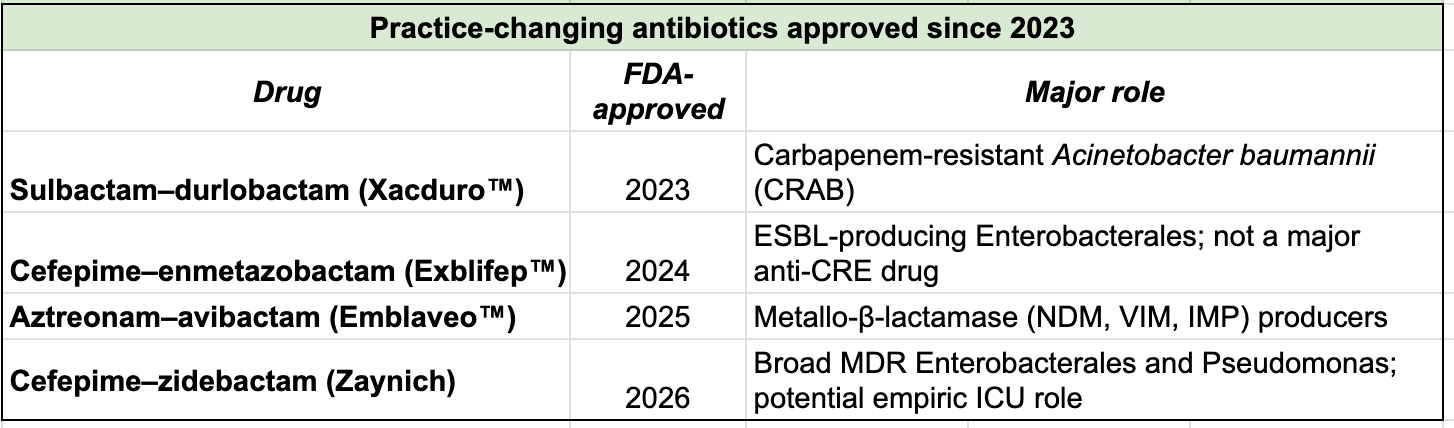
These have further expanded the armory of (still relatively new) antibiotics targeting drug-resistant infections:
Ceftolozane–tazobactam
Ceftazidime–avibactam
Meropenem–vaborbactam
Imipenem–cilastatin–relebactam
Cefiderocol
How to Use the New MDR-Active Antimicrobials
In the face of this massive expansion in complexity, the intensivist’s role remains clear. When a patient’s antimicrobial resistance report has a lot of Rs in it, red and/or bold font, or acronyms like MBL, KPC, AmpC, CTX-M, NDM, CRE, or OXA-48, call ID and ask for something extra-hyphenated.
But seriously
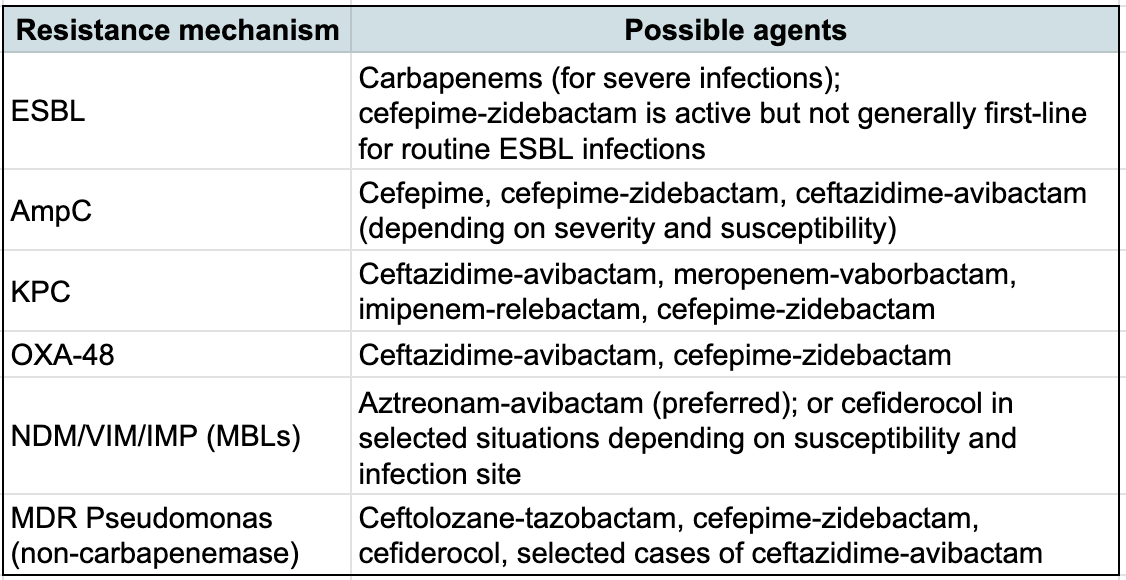
The good news is, it’s not necessary to memorize lists of organisms that each drug covers. Instead, laboratories and antimicrobial stewardship programs now think in terms of resistance mechanisms:
New Drugs, Old Practice Patterns
Prescribing these drugs is restricted to infectious diseases specialists. This reduces overuse and preserves the new antimicrobials’ effectiveness, but at the expense of delays in care.
Speaking of delays: hospitalists and intensivists check labs in the morning, while microbiology updates, including speciation and drug resistance, are at many centers updated silently in the electronic record in the afternoon—without notifying the treating clinicians that the patient is on an ineffective antibiotic.
Operationally, that has traditionally resulted in a clinical timeline that often looks something like this:
Day 0, 9 pm: A patient is admitted to ICU from a skilled nursing facility or long-term acute care hospital, or a long-stay ICU patient develops new sepsis physiology. Pip-tazo is ordered; cultures are collected.
Day 2, 6 pm: Gram-negative rods are noted to be growing in blood cultures. The patient is not improving. Pip-tazo is changed to meropenem; ID is consulted electronically, with a sign-out to call them in the morning.
Day 3, 8 am: ID changes antibiotics to a newer-generation agent. At 1 pm, cultures and sensitivity reveal extensively resistant Enterobacterales species.
Initial empiric coverage was appropriate. An ID specialist was consulted. The new agent covers the infection. The care standard was met!
But after 48 hours without optimal antibiotic therapy, the patient’s sepsis has worsened significantly.
It Could Look Like This Instead
At many centers today, blood cultures incubate continuously in an automated instrument (e.g., BACTEC™, BacT/ALERT™, or VersaTREK™). When bacteria multiply enough to produce detectable CO₂ or other metabolic changes (in as little as eight to 24 hours for Gram-negative rods), the instrument flags blood cultures as positive.
Then, mass spectrometry (MALDI-TOF) can measure a protein “fingerprint” (primarily abundant ribosomal proteins) unique to each organism, identifying the species within 30 minutes.
Instead of waiting a day for resistance profile (the classic MICs on a Petri dish), PCR-based panels (BioFire’s BCID2™; Verigene™; ePlex™) can detect major resistance genes directly from the positive blood culture, within two hours after the culture turns positive.
If 12 hours after blood culture collection, these tests strongly suggest Klebsiella pneumonia expressing the KPC resistance gene, it’s highly likely to be carbapenem-resistant.
That’s the time to switch from piperacillin-tazobactam or meropenem to an advanced combination agent—not 24 hours and an ID consult later.
Even if the results come back at three in the morning.
Re-Engineering Resistant Infection Management
Although the algorithms would be complex, EMR-based decision support tools and human workflows could and should address this clinical problem/opportunity.
Identification of resistance genes in a patient with newly positive blood cultures isn’t a bland background update, especially if the patient displays sepsis physiology. It should require the same documented chain of communication and readbacks as any other critical lab.
EMR logic could display popups warning of the health threat, suggesting a menu of potential antimicrobials, with any clinician authorized to prescribe the appropriate agent while ordering an infectious diseases consult.
Cefepime-zidebactam’s broader use cases compared to the other more focused combination agents raise the question if it should be used empirically by intensivists instead of meropenem for very specific situations (e.g., high risk for carbapenem-resistant Enterobacterales), or for patients who deteriorate while on meropenem.
When otherwise serious people argue that antibiotics must be given within one hour of arrival to the ED, it’s hard to watch the sickest and most vulnerable patients in the hospital go days without receiving appropriate antimicrobials.
Only a few years ago, that was an unfortunate but understandable limitation of technology. But we have the tools to do better now.
Will we?
References
Genov P, Mladenov B, Slaitas D, et al. P-1209. Efficacy of β-lactam Enhancer Based Zidebactam-Cefepime Combination (WCK 5222) versus Meropenem in Adults with Complicated Urinary Tract Infection (cUTI) or Acute Pyelonephritis (AP) in a Global, Randomized, Double-blind, Phase 3 Trial. Open Forum Infectious Diseases2026;13(Supplement_1). Accessed July 29, 2026. https://academic.oup.com/ofid/article/13/Supplement_1/ofaf695.1402/8421223
Matrix-Assisted Laser Desorption/Ionization Time of Flight Mass Spectrometry (MALDI-TOF MS) Analysis for the Identification of Pathogenic Microorganisms: A Review. Microorganisms. 2021. Chen XF, Hou X, Xiao M, et al
Performance of BioFire Blood Culture Identification 2 Panel (BCID2) for the Detection of Bloodstream Pathogens and Their Associated Resistance Markers: A Systematic Review and Meta-Analysis of Diagnostic Test Accuracy Studies. BMC Infectious Diseases. 2022. Peri AM, Ling W, Furuya-Kanamori L, Harris PNA, Paterson DL.
Multidrug-Resistant Gram-Negative Bacterial Infections. Lancet. 2025. Macesic N, Uhlemann AC, Peleg AY.
Usefulness of BioFire FilmArray BCID2 for Blood Culture Processing in Clinical Practice. Journal of Clinical Microbiology. 2021. Berinson B, Both A, Berneking L, et al.
Emerging Technologies for Rapid Phenotypic Antimicrobial Susceptibility Testing of Clinical Isolates of Bacteria. Journal of Clinical Microbiology. 2025. Rattin J, Boswell M, Rhoads D.