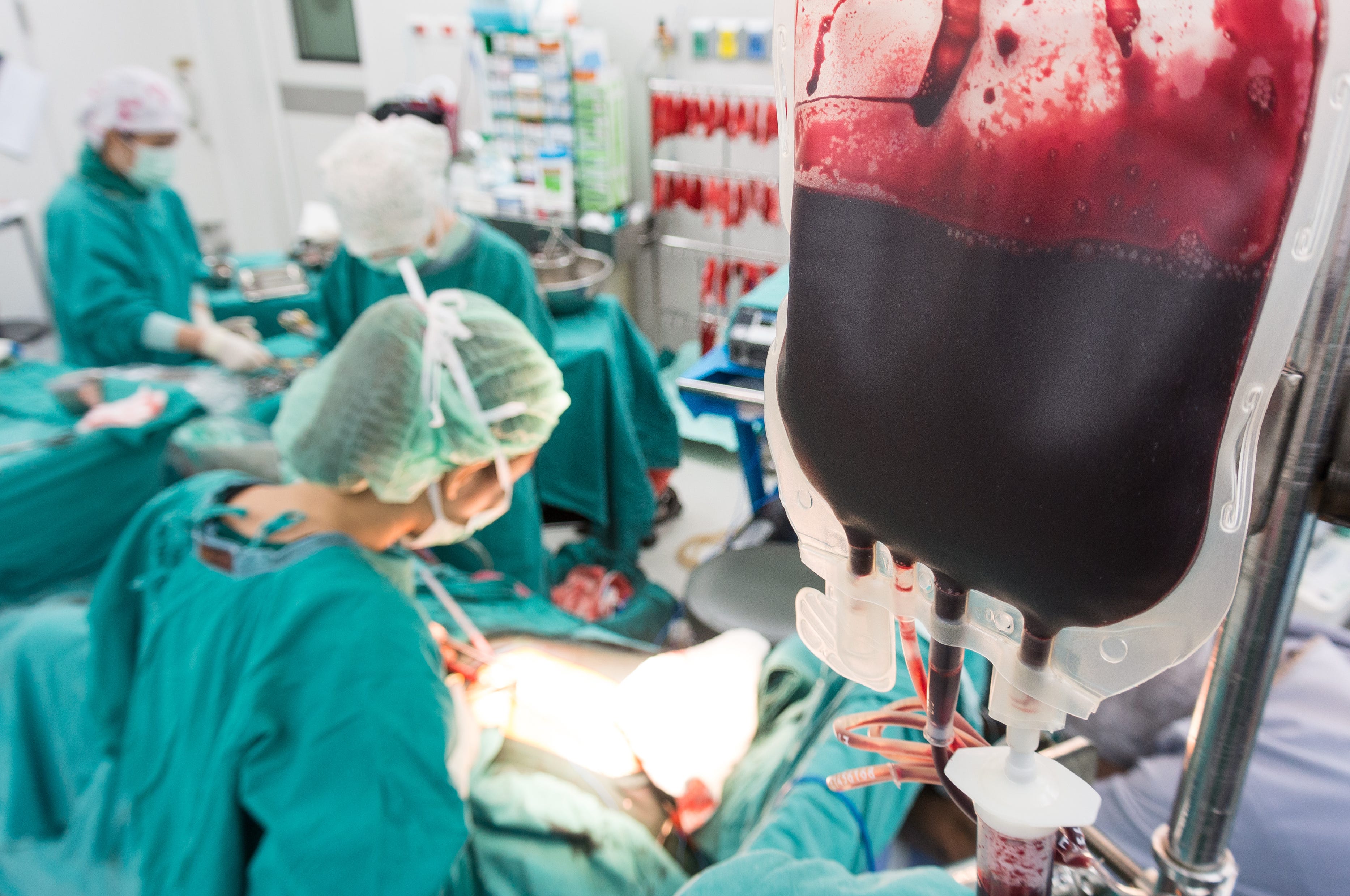
What's so great about whole blood? (Review)
A whole lot, observationally speaking, but RCTs are scarce
For much of the 20th century, blood transfusion meant whole blood transfusion, which was the standard both for replenishing ordinary anemia and as resuscitation for hemorrhagic shock.
There was no safety or efficacy reason why whole blood transfusion faded away. Rather, as technological and logistical advancements in the 1960s allowed for the efficient separation, storage, transport, and transfusion of the various components of whole blood (red cells, plasma, and platelets), transfusing components simply became the default.
Type-O whole blood (lacking AB antigens, a.k.a. “universal donor” blood) has continued to be used in emergencies, i.e., massive hemorrhages from trauma and gastrointestinal bleeding, with a large body of observational cohort data suggesting it might have advantages over component transfusions.
Recent research has focused on the use of so-called low-titer type O whole blood, which has minimal amounts of A and B antigen in its included plasma. This reduces the risk of transfusion reactions in recipients with blood types A, B, or AB.
Type-matched whole blood has also been extensively used in forward-deployed combat military units, particularly by the U.S. in Afghanistan.
Why Transfuse Whole Blood?
Whole blood is considered to be inherently more physiologic than blood components.
Transfusing whole blood seems to neatly solve the cumbersome ratio-calculating pertaining to massive transfusion of blood components (e.g., RBC:plasma:platelets). It can also be easier logistically and operationally.
Clotting factors are transfused in the same solution with red cells (not sequentially), theoretically enhancing coagulation.
Whole blood may maintain better oncotic properties, which could enhance resuscitation and perfusion for patients in shock.
Evidence for Whole Blood Transfusion in Hemorrhage
Excitement about whole blood transfusion originated from military experience.
In a small retrospective observational study (Spinella J Trauma 2009), 100 U.S. military combat casualty patients who were transfused whole blood had >12% absolute improvement in 24-hour and 30-day survival compared to 254 transfused with component products.
This signal seemed to grow stronger over time.
Nonrandomized data from U.S. casualties in Afghanistan aligned with the Spinella data, followed by a larger observational cohort by Gurney et al (Surgery 2022) finding an enormous survival benefit (an adjusted odds ratio of 6-hour mortality of 0.27) for soldiers who were transfused warm fresh whole blood, as compared to soldiers transfused component products.
Warm fresh whole blood is typically collected from fellow pre-screened soldiers and transfused within hours, without any refrigeration. It has major logistical advantages over refrigerated blood in combat and forward-deployed scenarios.
In the observational studies, there was no apparent excess risk (such as for transfusion reactions) associated with whole blood, including type-O or recipient-matched whole blood.
Based on the Afghanistan data, warm fresh whole blood came to be considered by some experts to be the gold standard for hemorrhagic transfusion.
Whole Blood Transfusion for Trauma in Civilian Populations
Based on the published military experience, efforts began in the U.S. trauma community to adapt blood banking operations to permit transfusion of whole blood in the prehospital and hospital settings.
Like the military studies, observational studies in the civilian trauma literature found associations between whole blood transfusion and improved survival:
In a registry of 501 participating U.S. centers, 2,884 trauma patients transfused whole blood had lower mortality at 4 hours (adjusted odds ratio: 0.81), 24 hours, and 30 days compared with component-only (Dorken-Gallestegi et al Ann Surg 2024),
840 trauma patients receiving whole blood in southwest Texas had a four-fold increase in survival odds, compared to component blood recipients (Brill et al J Am Coll Surg 2022),
1,180 whole blood recipients had twice the survival odds as component blood recipients at 14 U.S. centers (Hazelton et al Ann Surg 2022),
And a 37% lower risk for mortality with whole blood among 435 trauma patients in North American centers (Torres et al JAMA Surgery 2023),
Survival was also greater than predicted among patients transfused with whole blood pre-hospital (Rajesh et al, Am J Surg 2025).
A meta-analysis of 38 cohort studies (and two RCTs) including ~50,000 patients (JAMA Surgery 2022) found a large survival boost associated with whole blood transfusion in trauma (odds ratio 0.76 for death).
Of course, due to systemic, operational, and secular factors, the patients receiving whole blood in these studies were different from those receiving component blood.
And the totality of care provided to them was different.
In both measurable and unmeasurable ways.
That’s called confounding.
And we all know where this is going, don’t we.
Then Someone Had To Go And Run Randomized Trials And Ruin Everything
Whole blood has been tested directly against component blood in at least two randomized controlled trials. Both were firmly negative.
U. Pitt pilot study
Among 86 patients in a pilot study at U. of Pittsburgh, mortality at 28 days was virtually identical (25% vs 26%) with either whole blood or components transfused prehospital (Guyette et al J Trauma Acute Care Surg 2022)
SWIFT trial (NEJM 2026)
Among 616 patients transfused prehospital in air ambulances in England, those who were randomized to be transfused whole blood had numerically equal or higher mortality at all time points measured, from 6 hours up to 90 days after randomization. They also had near-identical rates of massive transfusion as those receiving component blood. Death and massive transfusion were combined into a composite outcome, which did not differ between groups. (Smith et al NEJM 2026)
Patients only received up to two units of red cells prehospital, which leaves open the possibility of an inadequate dose to achieve a benefit.
Conclusion
Whole blood transfusion has a strong biologic rationale and has the potential to reduce the logistical complexity of hemorrhagic resuscitation. Although observational data from military and civilian settings strongly suggested advantages, randomized trials have thus far shown no benefit from whole blood over conventional blood component transfusions.
More data is coming. Randomized trials planned or in process for whole blood in trauma include the TROOP trial (U.S. trauma centers, n=1,100), MATIC-2 (in 1,000 U.S. children with traumatic hemorrhage), and a small RCT at Loma Linda.
References
Smith JE, Cardigan R, Sanderson E, et al. Prehospital Whole Blood in Traumatic Hemorrhage — a Randomized Controlled Trial. New England Journal of Medicine. Published online March 17, 2026. doi:https://doi.org/10.1056/nejmoa2516043
Guyette FX, Sperry JL. Prehospital low titer group O whole blood is feasible and safe: Results of a prospective randomized pilot trial. J Trauma Acute Care Surg. 2022 May 1;92(5):839-847. doi: 10.1097/TA.0000000000003551. Epub 2022 Jan 25. PMID: 35081595; PMCID: PMC9038638.
Hazelton JP, et al. Use of Cold-Stored Whole Blood is Associated With Improved Mortality in Hemostatic Resuscitation of Major Bleeding: A Multicenter Study. Ann Surg. 2022 Oct 1;276(4):579-588. doi: 10.1097/SLA.0000000000005603. Epub 2022 Jul 18. PMID: 35848743.
Brill JB, et al . Impact of Incorporating Whole Blood into Hemorrhagic Shock Resuscitation: Analysis of 1,377 Consecutive Trauma Patients Receiving Emergency-Release Uncrossmatched Blood Products. J Am Coll Surg. 2022 Apr 1;234(4):408-418. doi: 10.1097/XCS.0000000000000086. PMID: 35290259.
Dorken-Gallastegi A, et al . Whole Blood and Blood Component Resuscitation in Trauma: Interaction and Association With Mortality. Ann Surg. 2024 Dec 1;280(6):1014-1020. doi: 10.1097/SLA.0000000000006316. Epub 2024 May 6. PMID: 38708894; PMCID: PMC11538373.
Spinella PC, Perkins JG, Grathwohl KW, Beekley AC, Holcomb JB. Warm fresh whole blood is independently associated with improved survival for patients with combat-related traumatic injuries. J Trauma. 2009 Apr;66(4 Suppl):S69-76. doi: 10.1097/TA.0b013e31819d85fb. PMID: 19359973; PMCID: PMC3126655.
Gurney J, Staudt A, Cap A, Shackelford S, Mann-Salinas E, Le T, Nessen S, Spinella P. Improved survival in critically injured combat casualties treated with fresh whole blood by forward surgical teams in Afghanistan. Transfusion. 2020 Jun;60 Suppl 3:S180-S188. doi: 10.1111/trf.15767. Epub 2020 Jun 3. PMID: 32491216.
Torres CM, Kenzik KM, Saillant NN, Scantling DR, Sanchez SE, Brahmbhatt TS, Dechert TA, Sakran JV. Timing to First Whole Blood Transfusion and Survival Following Severe Hemorrhage in Trauma Patients. JAMA Surg. 2024 Apr 1;159(4):374-381. doi: 10.1001/jamasurg.2023.7178. Erratum in: JAMA Surg. 2024 Apr 1;159(4):470. doi: 10.1001/jamasurg.2024.0324. PMID: 38294820; PMCID: PMC10831629.
Hanna K, Bible L, Chehab M, Asmar S, Douglas M, Ditillo M, Castanon L, Tang A, Joseph B. Nationwide analysis of whole blood hemostatic resuscitation in civilian trauma. J Trauma Acute Care Surg. 2020 Aug;89(2):329-335. doi: 10.1097/TA.0000000000002753. PMID: 32744830.
Ibrahim W, Meza Monge K, Menzel J, et al. Whole-Blood vs Component Therapy in Adult Trauma: An Updated Systematic Review and Meta-Analysis. JAMA surgery. Published online November 2026:e260197. doi:https://doi.org/10.1001/jamasurg.2026.0197