


In 2022, I started work on a play set in a very weird ICU, where estranged siblings Robbie and Sarah are brought together during their father’s critical illness and are compelled to face the truth about their troubled childhood.
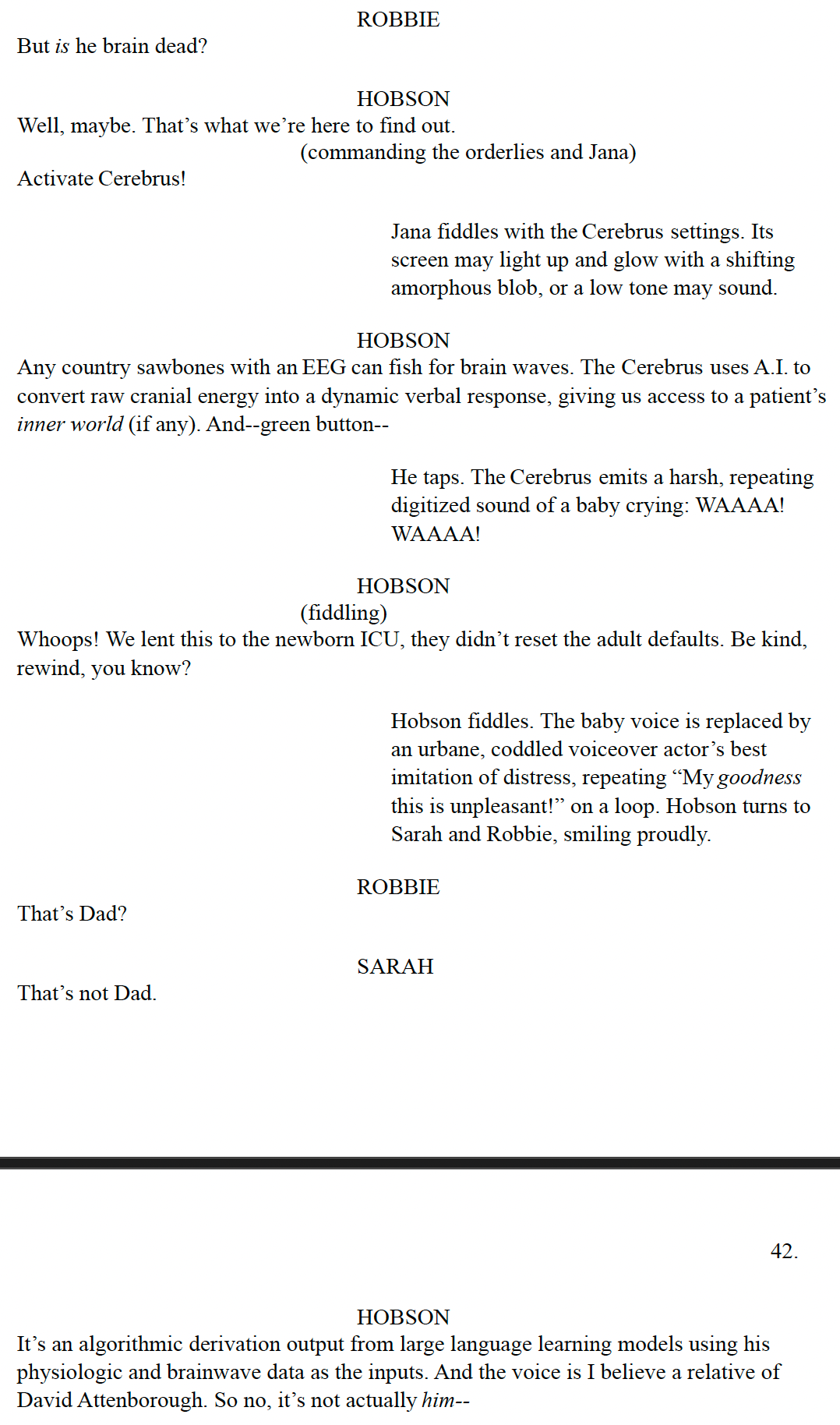
About midway through A Very Special Hospital, Dad has just achieved ROSC after a cardiac arrest. After congratulating himself, the grandiose Dr. Hobson and his nurse Jana fetch the Cerebrus: a machine that purports to detect consciousness and even read a comatose patient’s thoughts.
Two years later, investigators published evidence for the startling discovery that an unknown but significant portion of comatose patients experience “covert consciousness,” and are awake to some degree despite their physical unresponsiveness.
At the time, I mused that the discovery of comatose consciousness would produce a tectonic shift in how brain-injured patients are treated (both medically and interpersonally), and also dramatically complicate prognosis and counseling of families.
Many "vegetative" patients are conscious and responsive

Patients who become persistently encephalopathic after the resolution of severe illness (e.g., brain injury due to trauma, ischemic or hemorrhagic stroke) enter a liminal state of existence while those around them decide their fate.
How can we tell if an unresponsive patient is "in there"?

The critical care world was shaken to its psychological foundations by the discovery of cognitive motor dissociation, a phenomenon dubbed “covert consciousness” in which brain testing reveals that a non-trivial proportion of comatose patients can understand and execute cognitive commands such as “imagine yourself playing tennis”.
Tectonic, as in massive and slow, because there was no way to detect consciousness outside of research centers experienced in the fMRI and/or EEG techniques used to test for consciousness.
But that technology might be a bit closer than it seemed.
In an editorial in JAMA, two authors (renowned researchers in neurobiology and consciousness) capitalize on the recently publicized egregious failures in the organ donation system (in which a small number of patients intended for donation after circulatory death were discovered to be responsive and conscious) to raise broader concerns about widespread covert consciousness in this population.
Transplant surgeons allege corruption and mismanagement in organ transplant system
Critics of the shortcomings of the organizations responsible for organ donation and transplantation launched a surprise attack in a congressional subcommittee hearing this week.
Although subsequent news reports suggest there has been improvement in the processes of the criticized (and federally investigated) organ procurement organizations, the two JAMA authors point out that the prevalence of covert consciousness in organ donors remains completely unknown, and that there are inadequate procedures in place to check for it before withdrawal of life support and organ harvesting:

There is a vitally important discussion to be had around these issues, but I was distracted and intrigued by the conflict of interest disclosure for the second author, who reported holding “an executive position and having a financial interest in Intrinsic Powers Inc, a company whose purpose is to develop a device to assess the presence of consciousness.”
That device, dubbed “Presence,” uses a transcranial probe to stimulate the brain with magnetic energy (TMS), and algorithmic analysis of electroencephalography (EEG) patterns to identify consciousness from the response. It was patented in 2013 as a method of ensuring depth of anesthesia.
The inventors reported identifying nine possibly-conscious “vegetative” patients back in 2016 using the technology. The group has published numerous papers since, including most recently their efforts to create deep machine learning algorithms to identify consciousness by TMS-EEG using their growing datasets from variously brain-injured patients.
Bypassing the need for cumbersome fMRI and creating standardized device presets could theoretically enable a broad expansion of the technology, influencing decisions regarding withdrawal of life support for severely brain-injured patients.
TMS-EEG isn’t coming to your ICU anytime soon: Intrinsic Powers is still an early-stage startup (read their pitch deck here) seeking venture capital funding, apparently without much success thus far.
However, NIH’s reporting page announced $524,000 in seed funding in 2025 to help bring Presence “from a research prototype into a clinical device … a TMS-EEG system on a wheelable data acquisition cart with a new algorithm, with many fewer EEG electrodes (21 rather than 60), faster acquisition time and without the need of a patient-specific MRI.”
In 2025, a separate group at Stony Brook (NY) published results using AI analysis of facial movements to detect consciousness days before human eyes can recognize its signs. Those investigators have reportedly pursued patents, but commercialization will likewise be years away.
When such devices become available, the ICU will get even weirder. Until then, the critical care community will continue to fumble its way forward as we navigate the even more confounding environment produced by the existence of covert consciousness.
And yes, building in new extensive due diligence to avoid harvesting organs from conscious patients also sounds like a pressing and important endeavor. Let’s save that for a future post—organ donation after circulatory death is already a macabre business; covert consciousness turns it into a real-life horror show.
A Very Special Hospital was produced by Essential Theatre at 7Stages in Atlanta in August 2025, and out of the 43,240 PulmCCM subscribers invited, I want to sincerely thank the three of you who came. (That may be funny, but it’s not a joke—I really do appreciate it!)
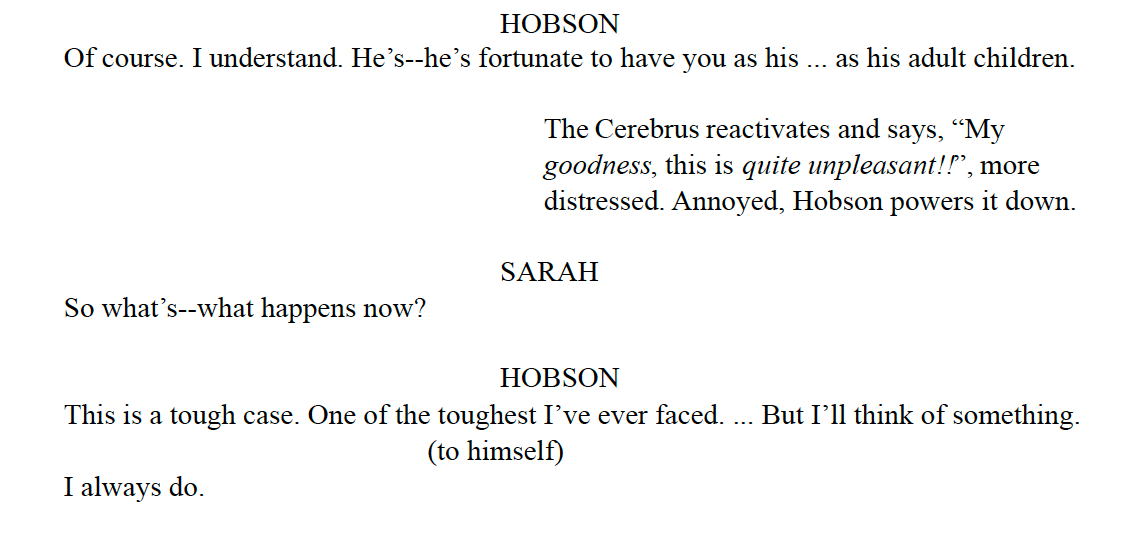
For those who missed it, the Cerebrus device wasn’t a game-changer in the play. Dad’s fate was determined by forces beyond anyone’s control—not that you could ever convince Hobson of that.
References
Young MJ, Koch C. Consciousness and Controlled Donation After Circulatory Determination of Death. JAMA. Published online January 26, 2026. doi:https://doi.org/10.1001/jama.2025.27045
Aubinet C, Claassen J, Edlow BL, Fischer D, Gosseries O, Koch C, Kondziella D, Massimini M, Young MJ. Covert consciousness: what's in a name? Brain. 2025 Dec 4;148(12):4248-4252. doi: 10.1093/brain/awaf349. PMID: 40985747; PMCID: PMC12677022.
Cognitive-Motor Dissociation and Time to Functional Recovery in Patients With Acute Brain Injury in the USA: A Prospective Observational Cohort Study. The Lancet Neurology 2022. Egbebike J, Shen Q, Doyle K, et al.
Prognosis for Patients With Cognitive Motor Dissociation Identified by Brain-Computer Interface. Brain : A Journal of Neurology. 2020. Pan J, Xie Q, Qin P, et al.
Recovery in Cognitive Motor Dissociation After Severe Brain Injury: A Cohort Study. PloS One. 2020. Jöhr J, Halimi F, Pasquier J, et al.
Recovery From Disorders of Consciousness: Mechanisms, Prognosis and Emerging Therapies. Nature Reviews. Neurology. 2021. Edlow BL, Claassen J, Schiff ND, Greer DM.
Covert Consciousness in the ICU. Critical Care Medicine. 2024. Edlow BL, Menon DK.
