

Whole blood transfusions prehospital: any benefit?
TOWAR and SWIFT trials test the strategy in severe hemorrhage

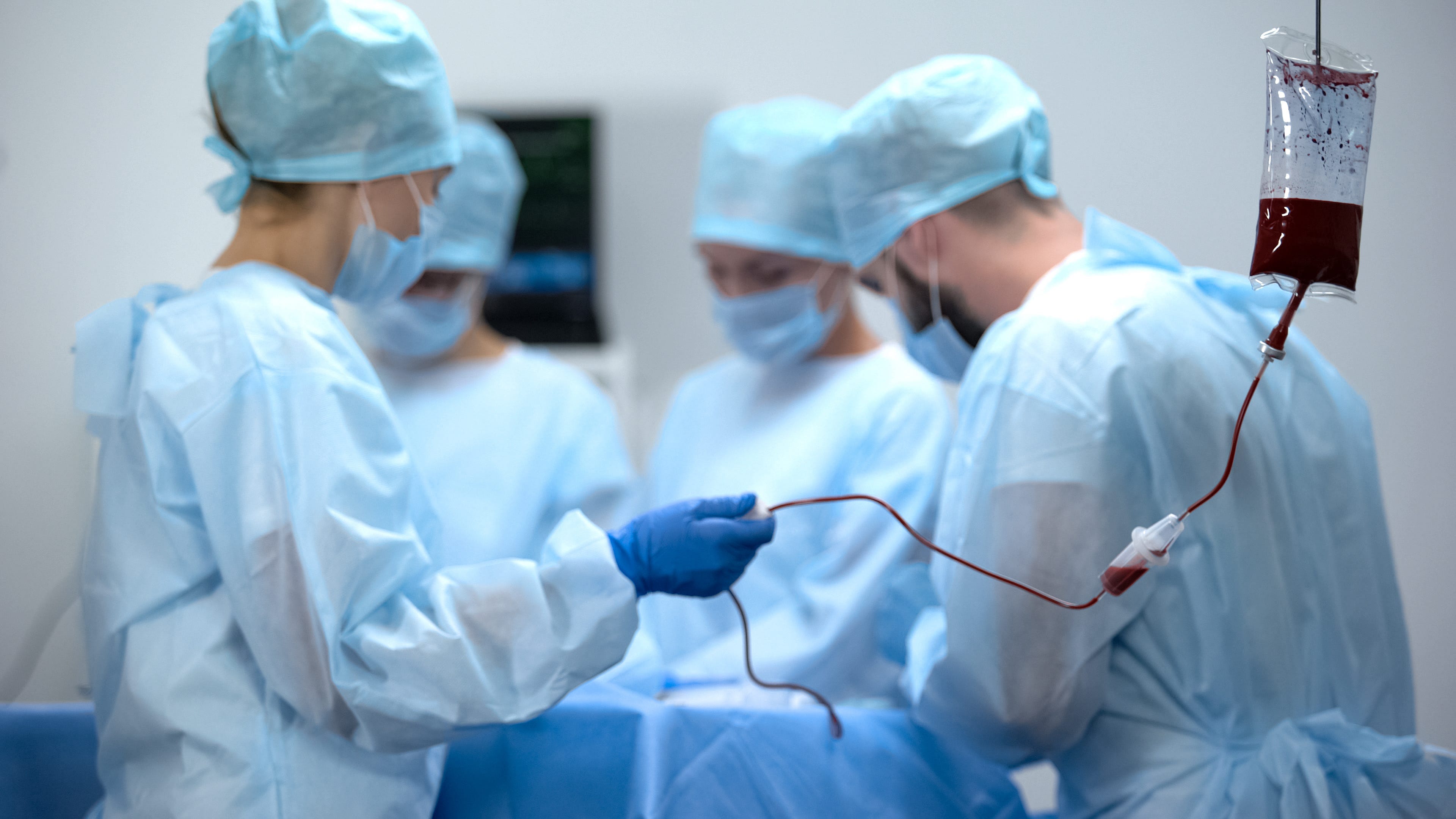
For patients with severe hemorrhage, transfusion with whole blood has theoretical advantages over component blood products: whole blood is a complete, balanced resuscitation fluid that can also reverse coagulopathy with native plasma proteins.
Observational studies both in military and civilian settings have suggested whole blood may be superior to component blood transfusion for hemorrhage.
What's so great about whole blood? (Review)

For much of the 20th century, blood transfusion meant whole blood transfusion, which was the standard both for replenishing ordinary anemia and as resuscitation for hemorrhagic shock.
In forward-deployed military units, whole blood has the advantage of not always requiring refrigeration—it can be drawn from active-duty personnel and transfused warm within hours.
Such a “just-in-time,” on-demand approach to transfusion creates its own logistical challenges, however, and so in U.S. military forward deployments today, warm blood transfusion from matched active-duty donors tends to be paired with stored low-titer group O whole blood, which requires refrigeration but still retains logistical simplicity compared to a component strategy.
The relative simplicity and theoretical physiologic advantages of a whole-blood approach to transfusion led to its expansion into the civilian trauma community in the 2010s.
Prehospital whole blood transfusion has been tested in two randomized trials to date.
SWIFT Trial
The SWIFT trial (Smith et al NEJM 2026) did not demonstrate benefit from transfusing up to two units of whole blood in hemorrhaging civilian trauma victims in the U.K. en route by air ambulance to trauma centers, as compared to transfusion with standard blood components.
Among 616 patients transfused prehospital, those who were randomized to whole blood had numerically equal or higher mortality at all time points measured, from 6 hours up to 90 days after randomization. They also had near-identical rates of massive transfusion as those receiving component blood. Death and massive transfusion were combined into a composite outcome, which did not differ between groups.
TOWAR Trial
In the TOWAR trial, 1,020 traumatically hemorrhaging casualties were transfused with either up to two units of low-titer group O whole blood or component blood products, in 44 air medical bases that initiated the intervention in a cluster-randomized design.
At 30 days, all-cause mortality was numerically higher in the whole-blood group (25.9% vs 20.5%; non-significant, confidence interval 0.87 to 1.76; P=0.24). There was no detectable difference in adverse events between the two groups.
In an observational substudy, the age of the blood (at 1 to 14 days old, vs. 15 to 21 days old) had no association with mortality (an odds ratio of 0.99).
TOWAR was a pragmatic trial and was consequently “messy” to the expected extent, with numerous crossovers in both directions; many patients were transfused before enrollment; coagulation parameters were not obtained.
Is Two Units of Whole Blood Enough? TROOP Trialists Intend to Find Out
In both the SWIFT and TOWAR trials, a maximum of two units of whole blood were transfused prehospital, raising the question of whether this was an adequate dose to produce a benefit.
Total volumes transfused were likewise low. In both SWIFT and TOWAR, 75% of patients were transfused a total of four units of blood or fewer in the first 24 hours.
Importantly, neither trial tested a whole-blood–predominant massive transfusion strategy. Most patients subsequently received conventional component-based resuscitation after hospital arrival.
Resuscitation from traumatic hemorrhage with whole blood is currently under more definitive study in the TROOP trial.
In TROOP, around 1,100 severely injured adults at 15 major U.S. trauma centers will be randomized to resuscitation with either low-titer type O whole blood or component blood products, with a primary outcome of 6-hour mortality and numerous secondary outcomes.
TROOP began enrolling patients in 2023 and is expected to be complete by mid-2027.
The Verdict
Whole blood transfusion for severe hemorrhage doesn’t clearly improve outcomes compared to component transfusion … when only two units of blood are transfused.
Whole blood provides logistical advantages in the military setting (and possibly civilian as well), but any health benefits have yet to be established in a randomized trial.
The TROOP trial will help to establish whether whole blood provides any real physiologic or survival benefits over component blood transfusion.
References
Sperry JL, Guyette FX, Cotton BA, et al. Prehospital Resuscitation with Type O Whole Blood for Trauma and Hemorrhage. New England Journal of Medicine. Published online May 18, 2026. doi:https://doi.org/10.1056/nejmoa2602167
Smith JE, Cardigan R, Sanderson E, et al. Prehospital Whole Blood in Traumatic Hemorrhage — a Randomized Controlled Trial. New England Journal of Medicine. Published online March 17, 2026. doi:https://doi.org/10.1056/nejmoa2516043
Guyette FX, Sperry JL. Prehospital low titer group O whole blood is feasible and safe: Results of a prospective randomized pilot trial. J Trauma Acute Care Surg. 2022 May 1;92(5):839-847. doi: 10.1097/TA.0000000000003551. Epub 2022 Jan 25. PMID: 35081595; PMCID: PMC9038638.
Hazelton JP, et al. Use of Cold-Stored Whole Blood is Associated With Improved Mortality in Hemostatic Resuscitation of Major Bleeding: A Multicenter Study. Ann Surg. 2022 Oct 1;276(4):579-588. doi: 10.1097/SLA.0000000000005603. Epub 2022 Jul 18. PMID: 35848743.
Brill JB, et al . Impact of Incorporating Whole Blood into Hemorrhagic Shock Resuscitation: Analysis of 1,377 Consecutive Trauma Patients Receiving Emergency-Release Uncrossmatched Blood Products. J Am Coll Surg. 2022 Apr 1;234(4):408-418. doi: 10.1097/XCS.0000000000000086. PMID: 35290259.
Dorken-Gallastegi A, et al . Whole Blood and Blood Component Resuscitation in Trauma: Interaction and Association With Mortality. Ann Surg. 2024 Dec 1;280(6):1014-1020. doi: 10.1097/SLA.0000000000006316. Epub 2024 May 6. PMID: 38708894; PMCID: PMC11538373.
Spinella PC, Perkins JG, Grathwohl KW, Beekley AC, Holcomb JB. Warm fresh whole blood is independently associated with improved survival for patients with combat-related traumatic injuries. J Trauma. 2009 Apr;66(4 Suppl):S69-76. doi: 10.1097/TA.0b013e31819d85fb. PMID: 19359973; PMCID: PMC3126655.
Gurney J, Staudt A, Cap A, Shackelford S, Mann-Salinas E, Le T, Nessen S, Spinella P. Improved survival in critically injured combat casualties treated with fresh whole blood by forward surgical teams in Afghanistan. Transfusion. 2020 Jun;60 Suppl 3:S180-S188. doi: 10.1111/trf.15767. Epub 2020 Jun 3. PMID: 32491216.
Torres CM, Kenzik KM, Saillant NN, Scantling DR, Sanchez SE, Brahmbhatt TS, Dechert TA, Sakran JV. Timing to First Whole Blood Transfusion and Survival Following Severe Hemorrhage in Trauma Patients. JAMA Surg. 2024 Apr 1;159(4):374-381. doi: 10.1001/jamasurg.2023.7178. Erratum in: JAMA Surg. 2024 Apr 1;159(4):470. doi: 10.1001/jamasurg.2024.0324. PMID: 38294820; PMCID: PMC10831629.
Hanna K, Bible L, Chehab M, Asmar S, Douglas M, Ditillo M, Castanon L, Tang A, Joseph B. Nationwide analysis of whole blood hemostatic resuscitation in civilian trauma. J Trauma Acute Care Surg. 2020 Aug;89(2):329-335. doi: 10.1097/TA.0000000000002753. PMID: 32744830.
Ibrahim W, Meza Monge K, Menzel J, et al. Whole-Blood vs Component Therapy in Adult Trauma: An Updated Systematic Review and Meta-Analysis. JAMA surgery. Published online November 2026:e260197. doi:https://doi.org/10.1001/jamasurg.2026.0197
Secondary outcomes include 24-h and 30-day or hospital mortality (whichever is earlier); prespecified complications; adjudicated cause of death; time to death; length of stay (ICU and hospital); and hospital-, ventilator- and ICU-free days; the incidence of major surgical procedures; time to hemostasis in those undergoing procedures with a hemostatic component; number and type of blood products used until hemostasis is achieved (and randomized products are discontinued), as well as after hemostasis has been achieved, to 24 h post-admission; discharge destination and functional status and quality of life at hospital discharge or 30 days, as measured by Glasgow Coma Scale (GCS) and EuroQol (EQ-5D) quality of life measurement.
is Trauma resuscitation with Low-Titer Group O Whole Blood Or Products: study protocol for a randomized clinical trial (the TROOP trial)
Evidence that whole blood is more immunomodulatory than leukoreduced whole blood and associated with increases in post-operative infections:
Jensen LS, Andersen AJ, Christiansen PM, Hokland P, Juhl CO, Madsen G, Mortensen J, Møller-Nielsen C, Hanberg-Sørensen F, Hokland M. Postoperative infection and natural killer cell function following blood transfusion in patients undergoing elective colorectal surgery. Br J Surg. 1992 Jun;79(6):513-6. doi: 10.1002/bjs.1800790613. PMID: 1611441.
Evidence that whole blood is more immunomodulatory than red cells and may mediate increases in cancer recurrence.
Blumberg N, Heal J, Chuang C, Murphy P, Agarwal M. Further evidence supporting a cause and effect relationship between blood transfusion and earlier cancer recurrence. Ann Surg. 1988 Apr;207(4):410-5. doi: 10.1097/00000658-198804000-00007. PMID: 3355265; PMCID: PMC1493418.
Evidence that the inflammatory effect of transfusions can be mitigated by leukoreduction combined with washing away stored supernatant in pediatric cardiac surgery.
Cholette JM, Henrichs KF, Alfieris GM, Powers KS, Phipps R, Spinelli SL, Swartz M, Gensini F, Daugherty LE, Nazarian E, Rubenstein JS, Sweeney D, Eaton M, Lerner NB, Blumberg N. Washing red blood cells and platelets transfused in cardiac surgery reduces postoperative inflammation and number of transfusions: results of a prospective, randomized, controlled clinical trial. Pediatr Crit Care Med. 2012 May;13(3):290-9. doi: 10.1097/PCC.0b013e31822f173c. PMID: 21926663; PMCID: PMC3839819.
There are ancient data suggesting that surgical patients have worse outcomes with whole blood than with red cells. This is in the setting of cancer surgery, not trauma. This is particularly true with non-leukoreduced whole blood, which was used in some centers in the SWIFT study. The supernatant of whole blood contains many potent biological toxins, including DNA, histones, NETs, cytokines, microvesicles, etc. These are present in lower quantity in red cell concentrates. Thus one question is whether red cells and crystalloid would be as effective and less toxic in patients needing only a few units of blood. The assumption that a patient who needs only, let's say 3-5 units of red cells benefits from plasma, platelets, etc. in terms of hemostasis and physiology is based upon expert opinion and no data that I am aware of. The existing literature has paid essentially no attention to the extensive data that transfusions harm patients immunologically in a dose dependent fashion. Infection (nosocomial), inflammation and thrombosis are causally linked to transfusions in randomized trials. These can be mitigated in randomized trials by leukoreduction and supernatant removal (washing), which is the exact opposite of what is being done in these trials.